Art History I El4002 Which of the Following Is Not a Characteristic of Romanesque Architecture?
The Romanesque period in Europe'due south history started effectually the mid-xthursday century CE until the 12thursday Century CE. As an art movement, information technology occurred throughout Europe and had different regional styles. It was primarily a big-calibration architectural style that emulated the Classical Roman styles from the Artifact and Byzantine periods. Other fine art forms like metalwork, sculpture, painting, embroidery, and stained glass would deed as adornments and decorations for churches.
Table of Contents
- 1 Romanesque Definition: "Debased Roman Architecture"
- two Out of the Dark Ages: A Brief Historical Overview
- two.ane The "Father of Europe"
- 2.two After the Carolingian Empire
- 3 Romanesque Art and Architecture
- iii.1 Romanesque Art Characteristics and Types
- iii.2 The Offset Romanesque Style
- 3.3 Norman Romanesque Style
- 3.4 Italian Romanesque Style
- 4 The Romanesque Style Continues to Influence
- 5 Oft Asked Questions
- 5.1 What Is Romanesque Art?
- v.2 When Did the Romanesque Period Starting time?
- 5.3 What Are the Characteristics of Romanesque Architecture?
Romanesque Definition: "Debased Roman Architecture"
The word "Romanesque" relates to the Romans, and is often explained as having "descended from [the] Romans". The suffix esque originates every bit a French term that refers to something that resembles something else. When information technology is placed behind a substantive, like "Roman" in this example, it ways it resembles the Roman mode. Notwithstanding, this term was also utilized to bespeak Romance or Romantic languages.
According to some scholarly sources, the term was offset utilized by the French historian and archaeologist, Charles de Gerville, in the nineteenth Century CE when he wrote a letter of the alphabet to his colleague, August Le Prévost, who was also an archeologist, historian, and geologist. De Gerville used the term romane in his letter every bit he described the compages he saw, which spanned from the 400s to 1200s CE.
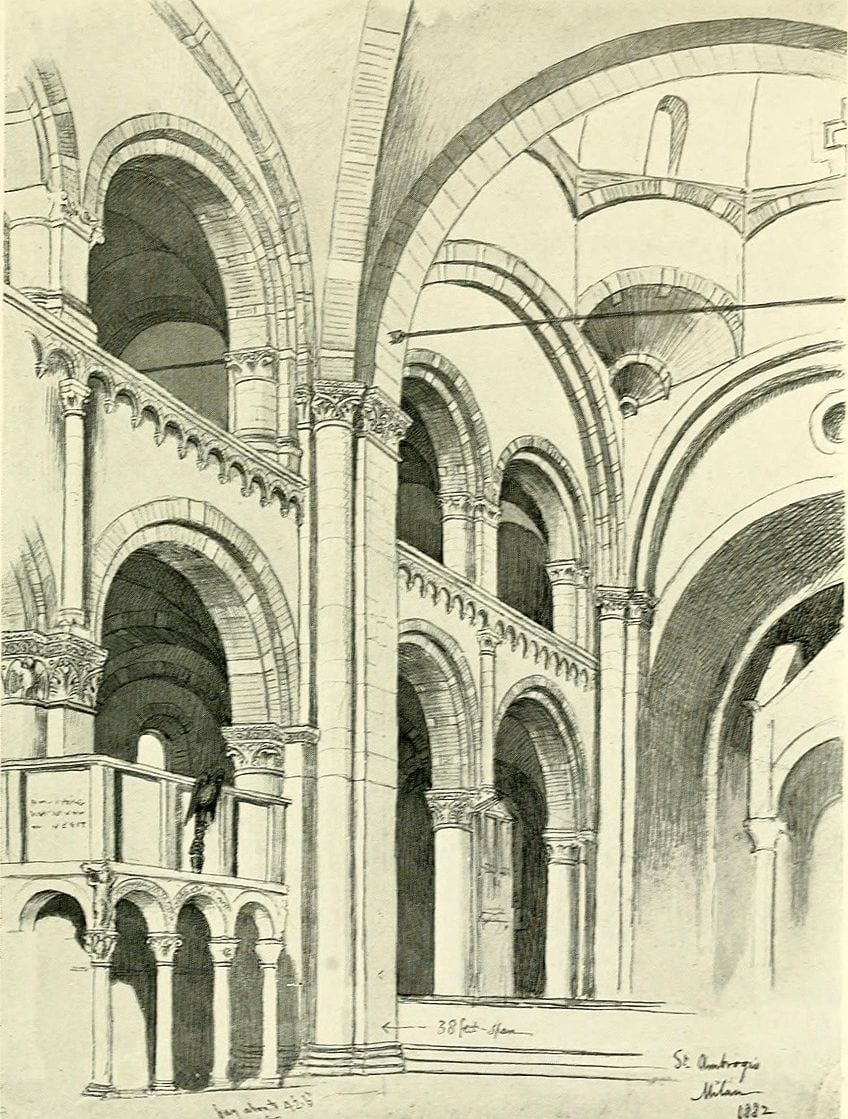 An instance of Romanesque architecture; Internet Archive Volume Images, No restrictions, via Wikimedia Commons
De Gerville's colleague, Arcisse de Caumont, described the compages he saw as "debased Roman architecture". He likened it to the Romance languages that were not Latin, describing them as the "degenerated Latin language".
The Romanesque definition was also expanded on by the English author, William Gunn. He utilized this term in an official publication to describe the architectural style from the Medieval period before the Gothic period. This was published in An Enquiry into the Origin and Influence of Gothic Compages (1819).
The term's usage evolved over time to designate the architectural style during the 900s until 1100s CE.
Out of the Dark Ages: A Cursory Historical Overview
Earlier nosotros look at the Romanesque fine art period, information technology will help us to understand how this period evolved. The Romanesque period took place during a fourth dimension in Europe'south history called the Medieval period, or Centre Ages. The Medieval period started with the autumn of the Roman Empire effectually 476 CE and lasted to around the late 1400s, which was when the Renaissance period brought new low-cal to a darkened Western world.
The Roman Empire fell because of the widespread disintegration of the political organization, invasions from Germanic and other tribes, as well equally many other debated factors related to its decline. The Roman Empire was also split into different parts, which weakened its power to fight back against the invading tribes.
The Medieval period (which developed after the Roman Empire'south destruction) has been divided into three periods: Early, High, and Late. During the Medieval period, at that place was new growth in the Western earth's economic system, society, religion, and cultures.
New kingdoms were existence shaped and with the influx of different cultures, languages evolved across just Latin and Greek.
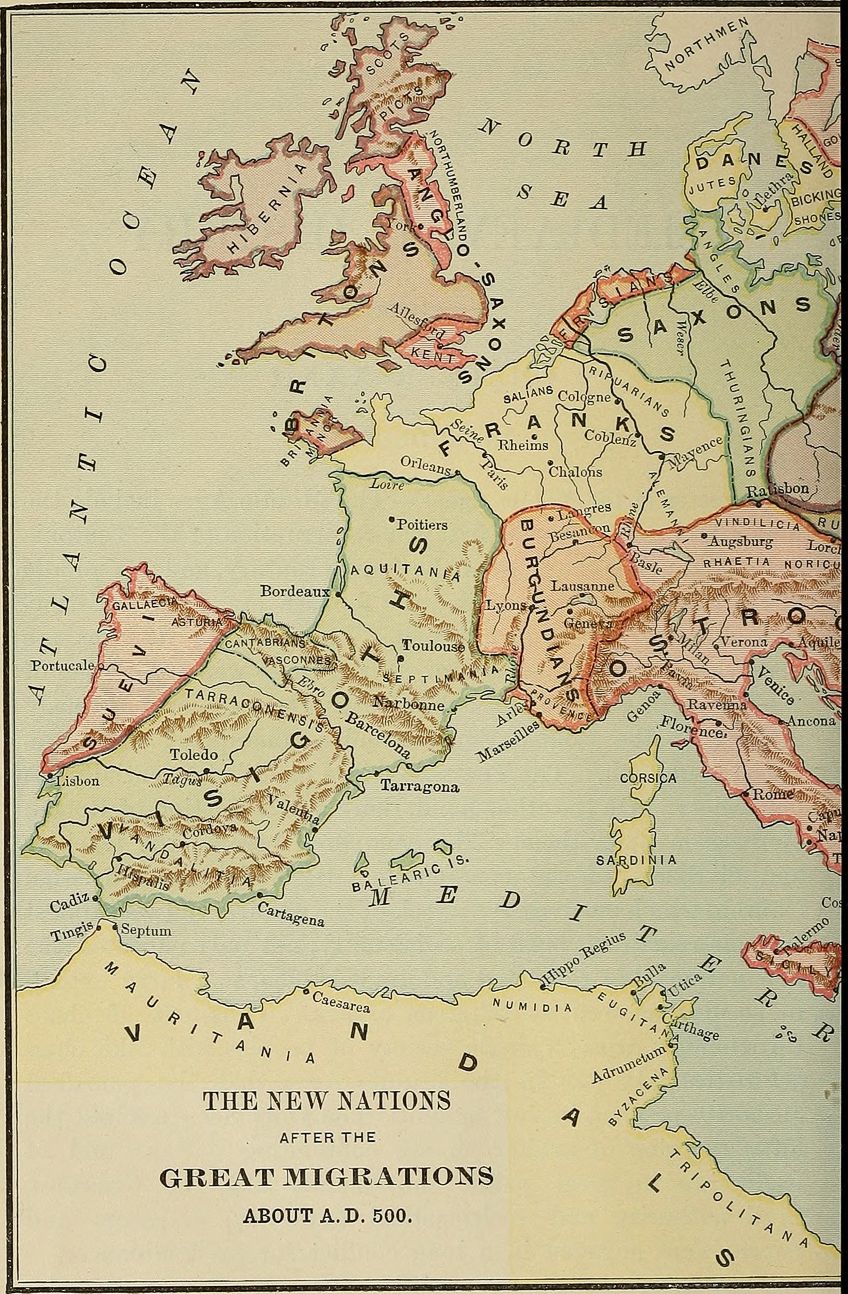 The new nations after the cracking migrations during A.D. 500; Net Annal Book Images, No restrictions, via Wikimedia Commons
The Migration Flow was besides some other office of the Medieval catamenia because, not just did various tribes invade the Roman Empire, but at that place was likewise a mass migration of these tribes into the Roman Empire. Some of the tribes were Germanic, similar the Anglo-Saxons, the Goths, the Lombards, the Vandals, and some were Eurasian like the Slavs.
During this period, at that place was also religious discord betwixt the Eastern and Western European countries. This was marked by what was known as the East-West schism in 1054 CE, where the Roman Catholic Church (which was run by the Pope in the West) was separated from the Eastern Orthodox Church in the East (run by the Ecumenical Patriarch of Constantinople).
There were thousands of changes and developments during the Medieval period – developments in politics, religion, and the arts throughout many countries. What is important to sympathize virtually this vast and complex time is that religion played an important role in society. The Early Middle Ages as well saw the rise of monasticism.
The "Father of Europe"
Charlemagne, otherwise known as Charles the Great, was a significant effigy during the Medieval menstruation considering he was responsible for the reunification of the Western and Primal European countries. His coronation as Emperor of Rome was held in 800 CE, and prior to this he was the Rex of the Franks in 768 and King of the Lombards in 774.
He was too the beginning emperor since the Roman Empire vicious (estimated around 3 centuries prior), and with this, he reunited regions in Western Europe that had non been united since. He came to exist considered as the "Male parent of Europe" considering of his unifying force.
The Carolingian Empire gave ascent to the Carolingian Renaissance, which was an important part of Medieval history because it was a period of cultural development in various disciplines like the arts, architecture, literature, music, and liturgical religious practices.
Charlemagne himself was a patron of the arts and he sought to emulate the ideals from the Classical Roman Empire by constructing various religious buildings; compages was an important part of the Carolingian Empire.
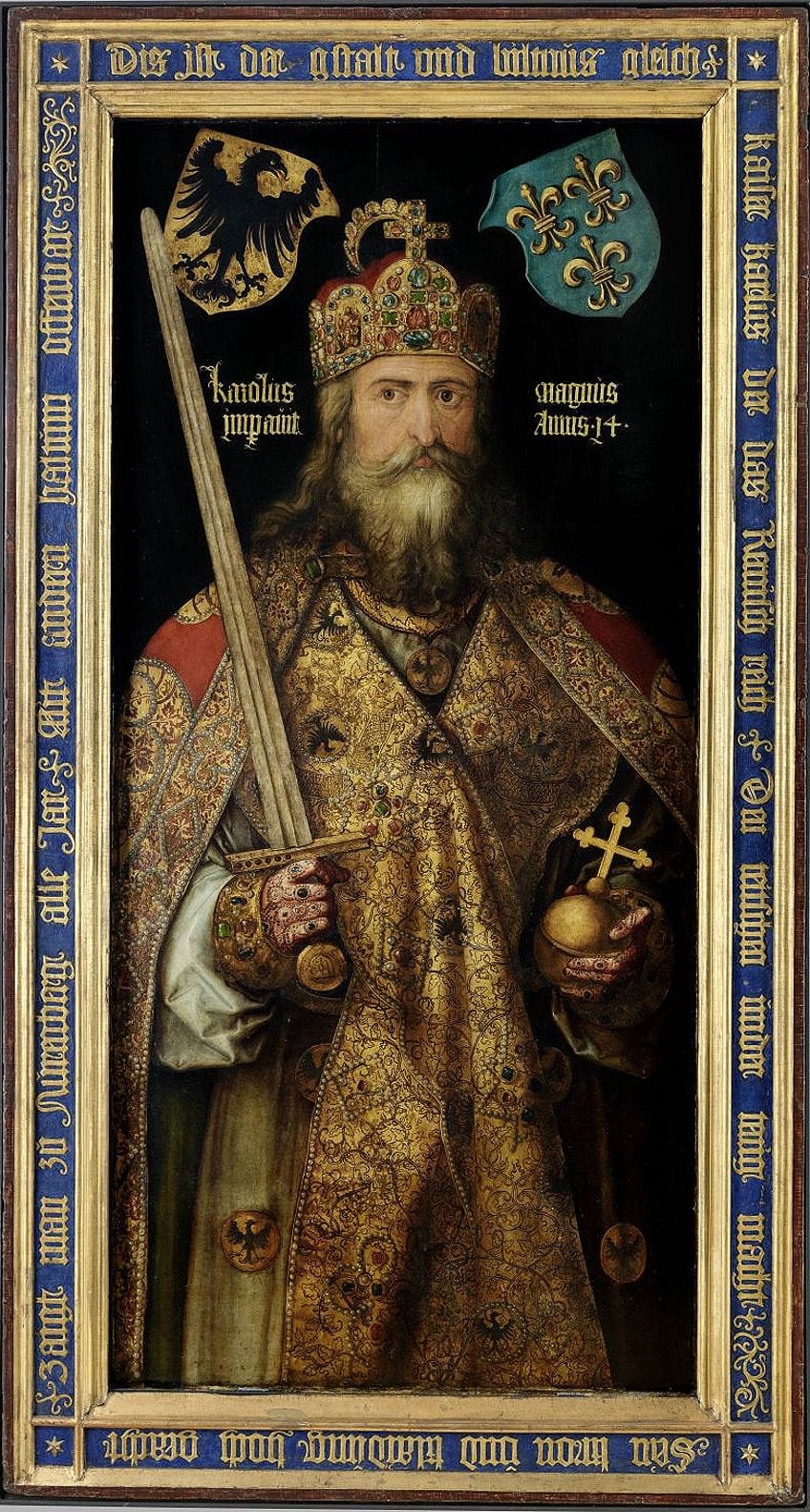 Emperor Charlemagne, painted by German language creative person Albrecht Dürer in 1511-1513;Albrecht Dürer, Public domain, via Wikimedia Commons
Professor of History, John Contreni, is often quoted providing estimates of simply how many buildings Charlemagne set out to build during his reign. Contreni stated that "the trivial more than eight decades between 768 to 855 alone saw the structure of 27 new cathedrals, 417 monasteries, and 100 royal residences".
There were influences from Roman and Byzantine styles in Carolingian compages, peculiarly when nosotros look at churches.
Churches were mostly built post-obit the layouts of basilicas, which were public buildings during ancient Roman times. The structure of the churches was besides changed to accommodate various religious ceremonies. Some of the changes consisted of the entrances becoming due west-facing, otherwise known as westworks, and the eastern ends of the church building housing the altars. The western fronts were ordinarily done at monumental scales.
These Carolingian architectural structures laid the foundation for the Romanesque periods to come, and are commonly described equally the Pre-Romanesque period in Northern Europe. An example of this is the Palatine Chapel in Aachen (792 to 805), which has the characteristic western front.
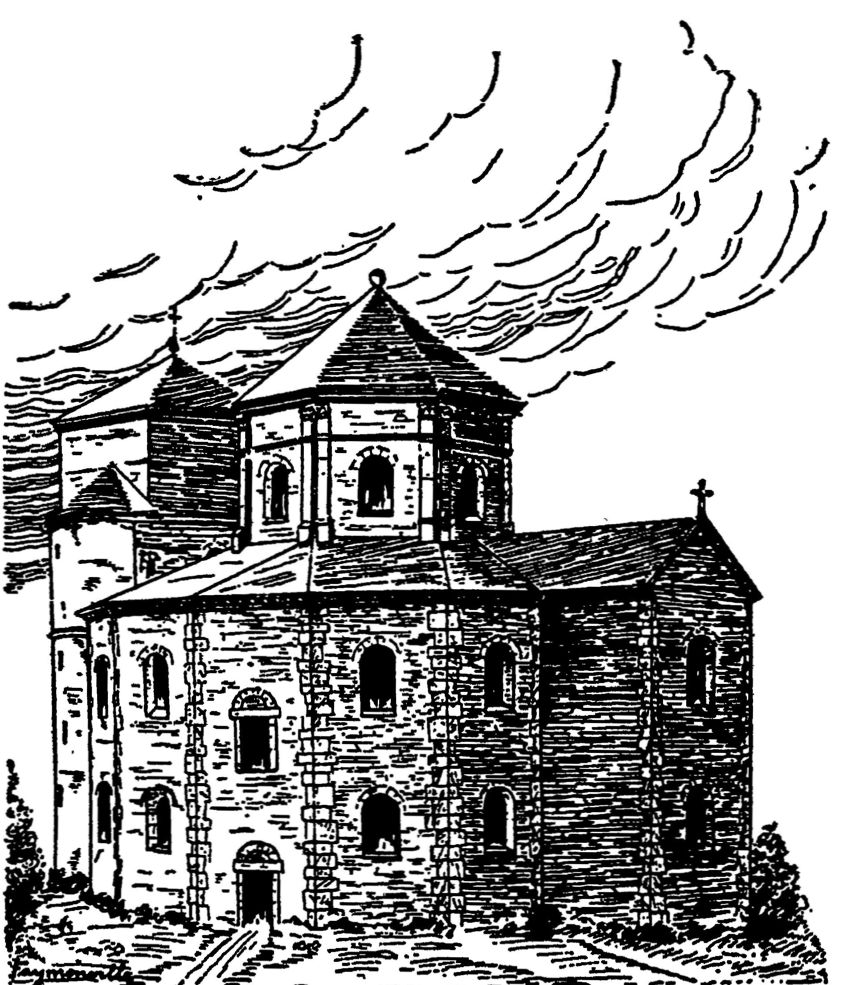 Charlemagne's church building in Aachen;Unknown author Unknown author, CC0, via Wikimedia Commons
The artwork produced during the Carolingian Renaissance was brusk-lived, however, only lasting between 800 to 900 CE. There was a resurgence of Roman influence, such as murals similar frescoes, mosaics, illuminated manuscripts, metalwork, and sculptures. Figures were as well depicted with more naturalism, as we run across from the Classical Roman murals.
Afterwards the Carolingian Empire
The Carolingian Empire came to an end during the 900s CE, and the period of what seemed to exist growth declined. In that location were various reasons for this – some of them included Viking invasions, which also saw the devastation and pillaging of many sacred churches.
The Ottonian Renaissance occurred during the reign of Otto I, or Otto the Great. His coronation as Holy Roman Emperor was in 962 CE. Equally another patron of the arts, art and architecture during this catamenia were primarily for the royal courts and monasteries.
This was not a widespread artistic or cultural move; however, it is important to place information technology contextually equally it was a forerunner to the Romanesque period.
Another important marker in Romanesque history was in 1066 when William, the Duke of Normandy, invaded England. At that place was an increase in buildings that acted every bit fortifications, like castles and strongholds, which also showed that it was Norman territory.
The Crusades during 1095 to 1270 CE also increased the spread of cultural ideas and diverse skills in crafts like masonry and metalworking. There was as well an influence from the Eastern European style of compages, namely architectural domes from Constantinople.
Romanesque Art and Architecture
Romanesque art certainly evolved over many different periods in Western European history, with many figures in power rising and falling. The Romanesque style can be characterized by several features, however, what is important to notation is that despite there being many overall similarities, there were differences in the Romanesque architecture of different regions like Italian republic, the British Isles, French republic, and Normandy.
There were important historical factors that signified the Romanesque period too, for case, Monasticism. This became a widespread religious endeavor beyond Europe, and monasteries became centers where people could stay during pilgrimages. Additionally, these were sites that housed religious relics.
Beneath, we discuss diverse Romanesque art characteristics too every bit some of the prominent artworks similar paintings, ornaments, and tapestries from the master regional styles throughout Europe.
Romanesque Art Characteristics and Types
Romanesque architecture shares some common features regardless of the regional differences. It is often described as "sturdy" and "solid" in structure. Notable similarities across regions would exist thick walls, smaller windows, and columns, which would usually alternate with piers. Columns were fabricated in the form of stone drums, which were thick and large to provide enough stability and support for the walls, roof, and vaulting higher up.
Other mutual features included arches betwixt the columns and piers, as well as decorative arcades – either inside or outside – in the form of "blind" arcades. These were a series of archways with no openings, and typically with a wall behind it.
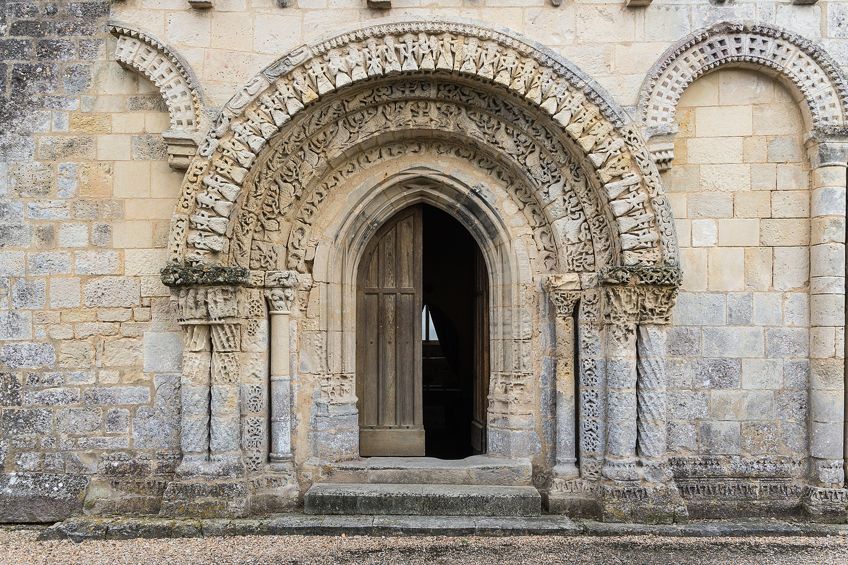 The Romanesque portal of the church of Our Lady in Avy, Charente-Maritime, France;Jebulon, CC0, via Wikimedia Commons
There were different types of vaulting, for example, the Barrel Vault, the Groin Vault, Ribbed Vault, and Pointed Arch Vault. Domes were likewise feature features in churches, and it is here that we often meet Romanesque paintings depicted as murals or mosaics, especially in the apse area.
When it comes to Romanesque paintings, not many have survived, although typical themes include that of the Terminal Judgment, Christ in Majesty, and various other scenes from the Former Testament. These were also painted on the arches, called the tympanum, to a higher place church entrances (these also included Romanesque sculptures).
Romanesque paintings were painted for didactic (educational) purposes due to many people being illiterate during the Medieval ages. Murals as well depicted the figure of Christ within an oval frame called a mandorla, where he would exist surrounded past various figures or animals from the Bible. The iconographic style from the Byzantine catamenia also stylized the various depictions of Christ.
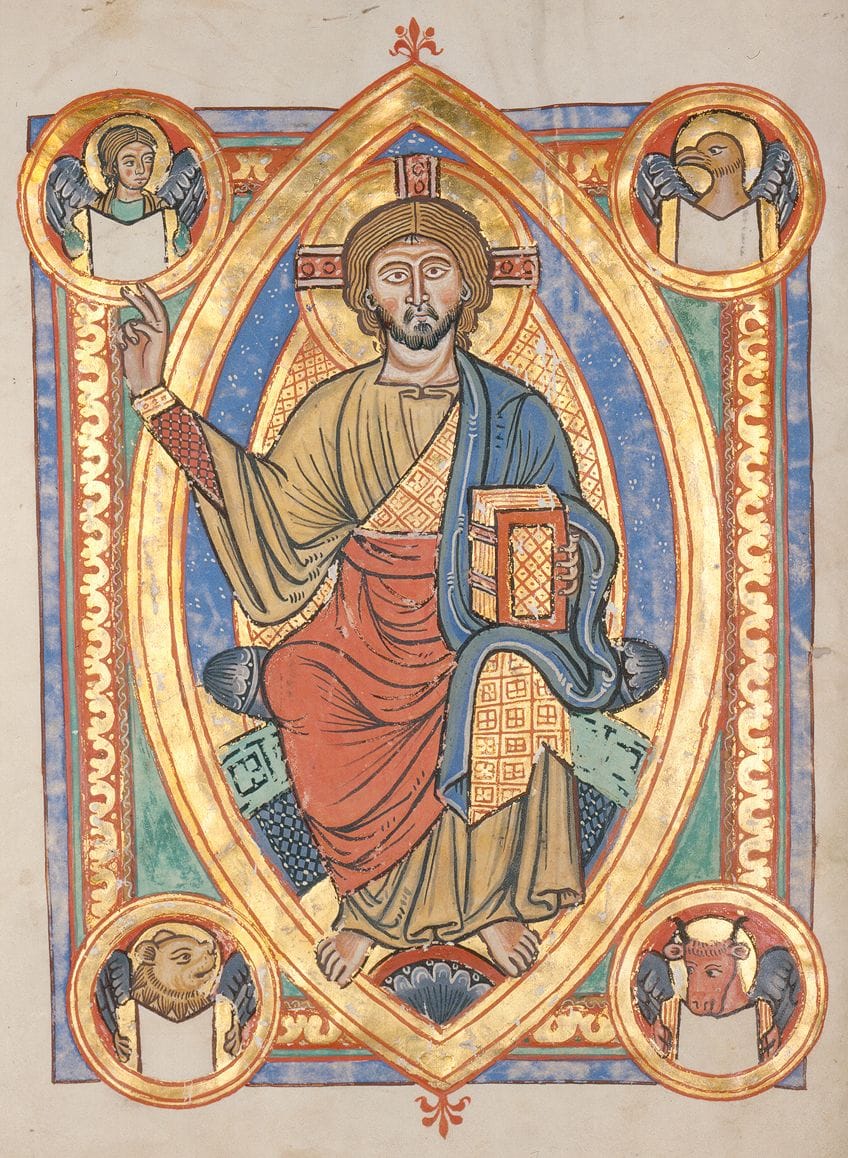 Christ mandorla in an illuminated manuscript, c. 1220;medieval, Public domain, via Wikimedia Commons
When we look at Romanesque sculpture, we encounter information technology in the capitals on columns, often in Corinthian Order, besides as on the tympanums in a higher place church entrances, which were washed in relief carvings. Although sculpture subject matter was often of biblical stories, at that place were other decorative motifs unremarkably used, such every bit spirals.
We see these types of decorative motifs in Roman architecture too, referred to by sources equally "scrolling vines".
These were also used to decorate manuscripts. An instance of the elaborate sculpture and decorative motifs is on the tympanum of Vézelay Abbey (c. 1120 t0 1150), which depicts images from the Beginning Cause and the Apostles' purpose to lead people towards God.
Other types of art were done with metalwork, ivory, and enamel. These would ofttimes be used to brand sacred objects. For example, the famous Stavelot Triptych (c. 1156 to 1158), which is made from gold and enamel, is a mobile altar made past Mosan artists from the Meuse Valley located in Belgium. Mosan artists created varieties of metalwork, stonework, enamel work, likewise as illuminated manuscripts.
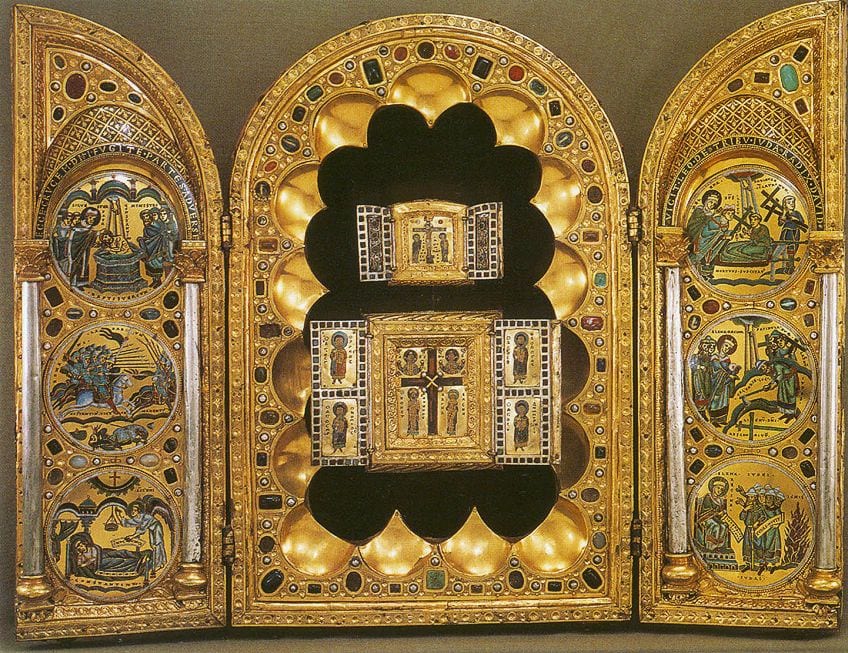 Stavelot Triptych (c. 1156 to 1158);Original File Uploaded by en:User:Stbalbach, Public domain, via Wikimedia Commons
Embroidery and stained-glass windows were too different types of artworks that were frequently utilized as decorations inside the churches. We see stained glass windows more prominently during the Gothic menses, although sources suggest that remnants of the Romanesque period were used for rebuilding during the Gothic menses. Stained glass also replaced the utilize of tapestries.
The Cluny Abbey
The Cluny Abbey was a significant religious building during the 900s CE. Information technology began as a donation of state to form the hunting lodge of Duke William I of Aquitaine. The abbey was started every bit a reform of the Dominion of St. Benedict. The abbey was also independently run – the Pope was the only authority over it. This enabled the abbey to build more monasteries in France, equally well as to fortify the Rule of St. Benedict.
Cluny'southward liturgy became well adult and considering of this, it grew into an important artistic hub.
Three successive churches were built at Cluny, which also highlights the characteristic Romanesque architectural style. There was Cluny I, Cluny 2, and Cluny 3. Cluny I was a simple structure in blueprint, but it was Cluny II that emulated the Romanesque designs.
 Footplan and hemi-perspective elevation of Cluny Abbey church building in late 17th / early 18th century;Pierre Giffart, Public domain, via Wikimedia Commons
Cluny Ii had the typical westworks, being the west-facing front with the two accompanying towers. Between the archway and the rest of church building inside was a narthex, which had a choir with two chapels on either side on the e-facing side of the church (nosotros see this fashion in future church designs).
The transept was situated just before the choir, horizontally crossing with the vertical nave, which gave the church the cruciform plan. The layout of the church was of a rectangular basilica, which consisted of a nave (the cardinal floor infinite) surrounded by aisles on both sides.
Other characteristics of Cluny Abbey were the barrel vaults and round arches, a typical feature of Roman architecture. Cluny 3 was rebuilt and finished ruing the twelvemonth 1130 and was considered the largest structure in Europe.
With additional embellishments to the already existing structures, it was a awe-inspiring sight to run across.
The Cistercians and Fontenay Abbey
The Cluny abbey became a circuitous structure and a powerful system within the reform movement – the Cluniacs were seen every bit also "worldly", having get likewise engrossed in earthly endeavors. This period of reform is referred to equally the Cluniac motion. Information technology was succeeded by the Cistercian motion. The Cistercians were monks that dissever from the Benedictine orders of Cluny to go along what they believed was in accordance with St. Benedict of Nursia'south fashion.
Fontenay Abbey is some other example of Romanesque architecture, founded past Saint Bernard of Clairvaux in 1118 CE.
In the programme of a Latin cantankerous, this church building was simpler in its pattern and construction, made from ashlar stone. In that location was a focus on reducing the number of decorative elements like towers and ornaments and so that the monks were not distracted.
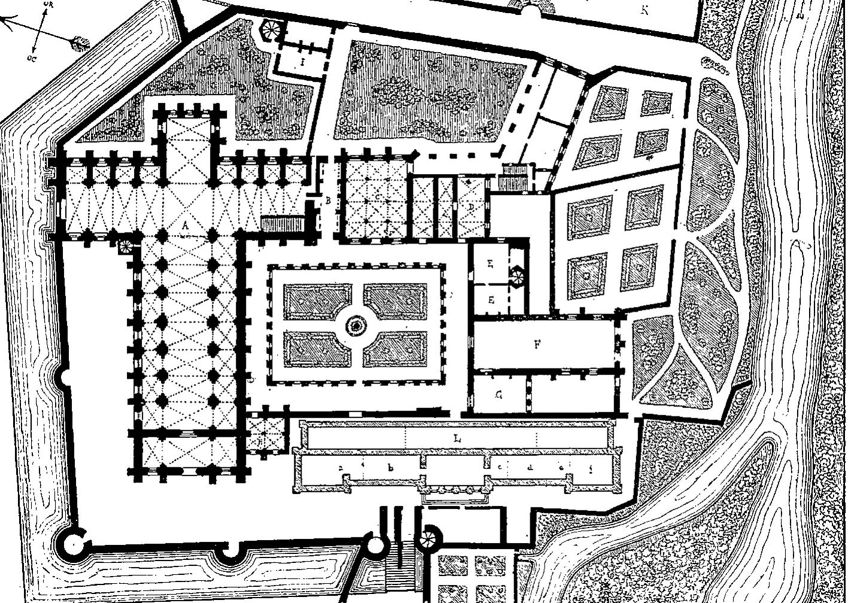 Fontenay Abbey and Cistercian architecture;Lucien Bégule (1912), Public domain, via Wikimedia Commons
Along the east side, the apse is flat, which is in contrast to the curved apses seen in other churches. There are also two chapels on either side, both square-shaped. We still encounter the classical Romanesque manner, however; in fact, the church has been described every bit a close correlation to that of Greek temple.
There is a nave with the accompanying side aisles. Forth the nave and well-nigh the end of it are barrel vaults, which have slight points (indicative of the Gothic style of compages). Nosotros also notice columns embedded in the nave columns, which extend into the above transverse arches.
The Showtime Romanesque Style
The Romanesque architectural styles took place regionally, which ways buildings had slight variations of way and building materials. When we wait at the Romanesque period in art information technology is subdivided, beginning with the First (or Lombard way) then the Romanesque style. The First style was coined as a term by Josep Puig i Cadafalch, who was a Spanish architect. He thought the Catalonian manner had similarities to the Romanesque period, although it took place during the later stages of the Pre-Romanesque menses.
The First way started in Lombardy in Italian republic during the 1000s CE, but also occurred in Catalonia in Spain, also as southern France. The Comacine Society was started past stonemasons in Lombardi, besides called the Magistri Comacini or Comacine masters, who pioneered this architectural fashion. Diverse sources indicate their commencement mention was by King Rothari of Lombard in his edict in the year 643 CE.
At that place are several distinguishing features of this style, namely that information technology was non elaborate in design or details and that at that place were no sculptures.
Information technology had thick walls, oft also described as "solid" in construction. The Lombard bands, also called "blind arches", are horizontal strips of arches without any opening placed beyond areas on the exterior of buildings. These were common features during this catamenia.
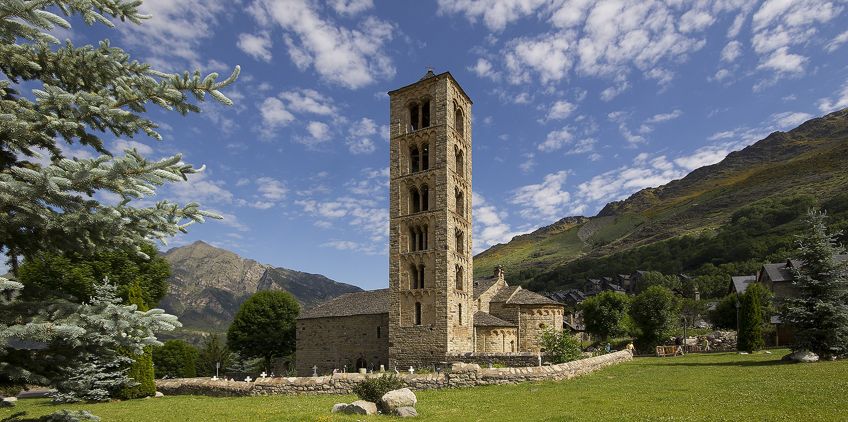 Sant Climent de Taüll in the Vall de Boí;Nur.ra, CC BY-SA 3.0, via Wikimedia Commons
There was too the use of open up arches, which would be vertically placed to beautify the exterior of the buildings. An example of this is the reconstruction of the front side of the Santa Maria de Ripoll Monastery (1032). Another instance includes the at present UNESCO World Heritage Site, Vall de Boí, which has nine church buildings located in the villages in the valley of the Pyrenees.
The churches in the valley have been noted for their architectural placement inside the rural areas of the Pyrenees. The churches were all built betwixt the 1000s and 1100s CE. An example of one of these churches is the Sant Climent de Taüll, which was constructed in 1123. This church is also one of the best-preserved churches in the valley.
The floorplan is in the basilica design with three naves. We will find the decorative arches, otherwise also known as "arcading" on the bell tower, or belfry, which consists of seven stories (although some sources say six stories).
There are no sculptural decorations on the exterior of the church building, and it appears "solid" in its simplicity, which is characteristic of the Romanesque style.
The interior of the church building has various mural paintings, which include the more than famous fresco titled, Christ Pantocrator (c. 1123), by an artist referred to equally the Chief of Taüll. It depicts the central effigy of Jesus Christ in a mandorla shape painted on the semi-round dome of the church (a common characteristic for paintings in churches).
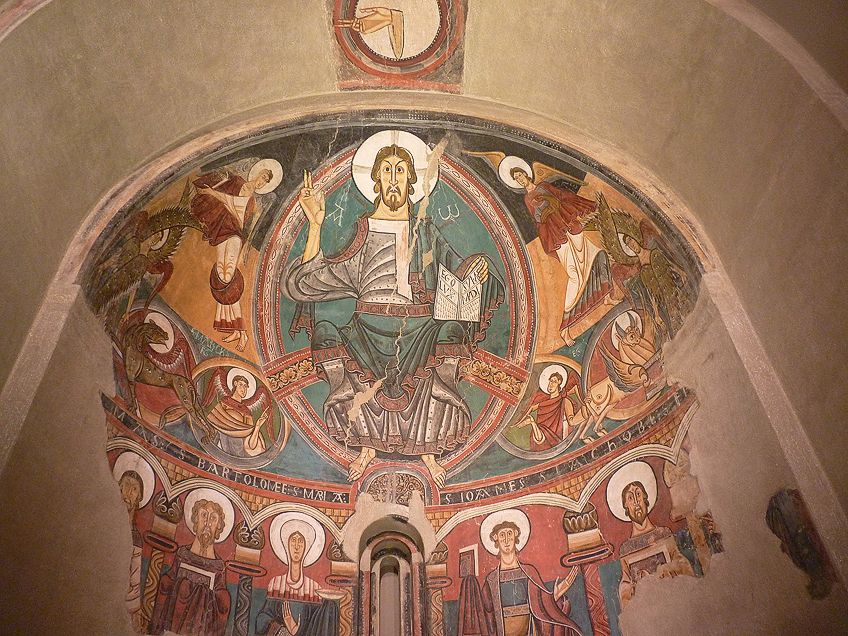 Christ Pantocrator (c. 1123) fresco in the apse of Sant Climent de Taül;David Monniaux, Public domain, via Wikimedia Commons
He sits with a small depiction of the earth below his feet. He holds upwards his right paw in the gesture of blessing and he holds a book in his left hand. At that place are diverse other biblical figures and animals surrounding the figure of Christ. The colors used are a diverseness of dejection, reds, and yellow. This painting has become well-known throughout history, with modern artists similar Picasso drawing inspiration from it.
Norman Romanesque Manner
The Norman Romanesque manner was an English style, primarily started past the Normans who were descendants of the Vikings – Normandy was also subsequently named later on these groups. The Norman manner adult from the resulting invasions around the twelvemonth 1066, which was when the Normans took over England.
The English architect, Thomas Rickman, coined the term "Norman Romanesque" in his publication, An Attempt to Discriminate the Styles of English Architecture from the Conquest to the Reformation (1817). This was the first usage of the term to describe the regional style amidst other sequential Romanesque styles.
The Norman style can be seen in churches and cathedrals, although in that location were also many castles and fortifications.
The style has rounded arches and is known to have large walls and proportions. The Norman arch was a common characteristic of this manner, which was ordinarily semi-circular in shape and congenital as large entrance entrances that created a sense of grandiosity.
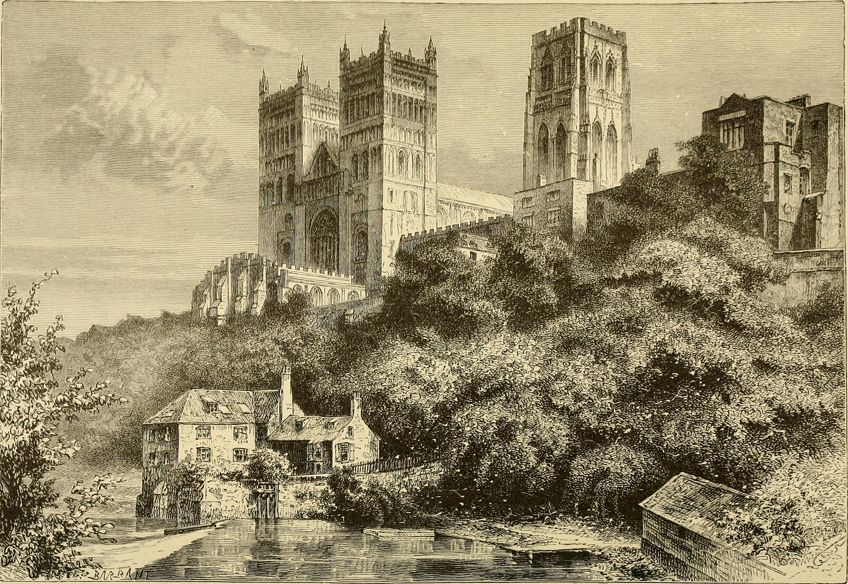 An 1881 drawing of Durham Cathedral; Reclus, Elisée, 1830-1905;Ravenstein, Ernest George, 1834-1913;Keane, A. H. (Augustus Henry), 1833-1912, No restrictions, via Wikimedia Commons
The Durham Cathedral (1093 to 1140) is an example of the Norman manner. It is one of the largest and most monumental structures e'er built and is renowned for its scale. Various structural elements include ornamental decorations. In fact, the building is copiously decorated in what is referred to as overlapping decorative arcading also every bit a characteristic ring of chevron-like zigzags, spirals, flutes, and lozenges forth with the thick columns and semi-circular arches.
The interior of the church has tall columns and piers likewise equally butt vaulting above. The whole interior appears awe-inspiring in scale. The meaning and motivation backside the large scale of the church take been a common question amid many scholars.
Another famous artwork from the Norman style is the Bayeux Tapestry (c. 1070), which depicts the historical events prior to and of the conquest of England between William, Duke of Normandy, and Harold Godwinson (Harold II), Earl of Wessex. The tapestry'due south length is 230 feet with over 70 scenes. There are Latin inscriptions, otherwise known every bit tituli, to describe the events, which are embroidered with woolen yarn into the textile (as opposed to being weaved on tapestries, which was the norm).
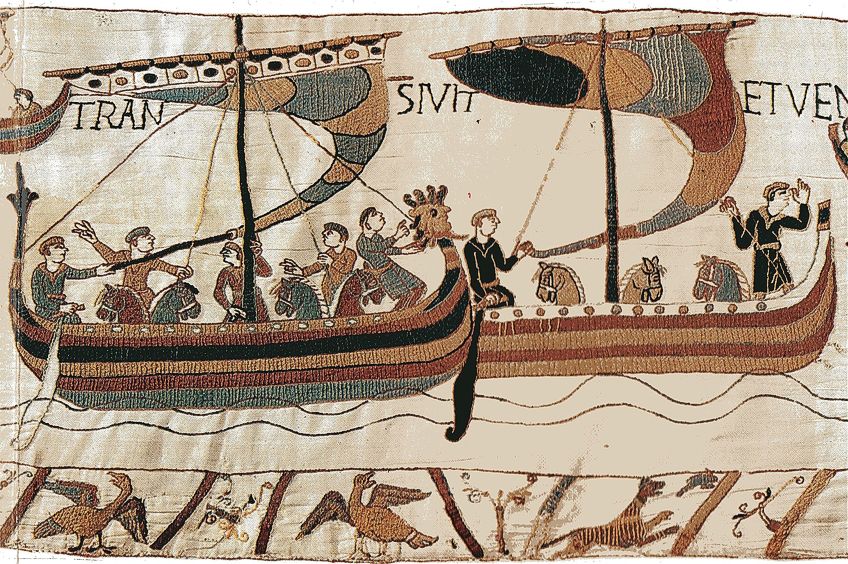 A scene of the Bayeux Tapestry depicting horses being shipped to England past Normans prior to their invasion, 11th century;Anonymous Unknown author, Public domain, via Wikimedia Commons
The commissioner or patron of the tapestry is reported by many scholars to have been the Bayeux Bishop named Odo (he was also the one-half-brother to the Duke of Normandy), who is as well depicted in the tapestry. The tapestry is believed to take been created in Canterbury, England, and depicts a more biased Norman perspective of the acquisition of England and the Battle of Hastings in 1066.
The "Bayeux Tapestry" is i of the more famous embroidered art pieces from the Norman fine art fashion.
On the larger macrocosm of the Romanesque fine art flow, this tapestry goes beyond the function as merely art because it is a rich and detailed depiction of war, politics, and a record of how the Normans prepared for battle, dined, and engaged with one another.
Italian Romanesque Way
The Italian Romanesque style, especially the Pisan Romanesque style (as well called the Tuscan manner), occurred during the 1000s CE to 1200s CE. It was characterized past more elaborate sculptural decorations, inside and outside the church building. We will also notice numerous decorative arcades.
A famous example is the Piazza dei Miracoli or Piazza del Duomo ("Cathedral Square"), the architectural complex housing the Pisa Cathedral (1063 to 1092), the Pisa Baptistry (1153), and the famous Leaning Tower of Pisa, also called the Campanile (1173 to 1372).
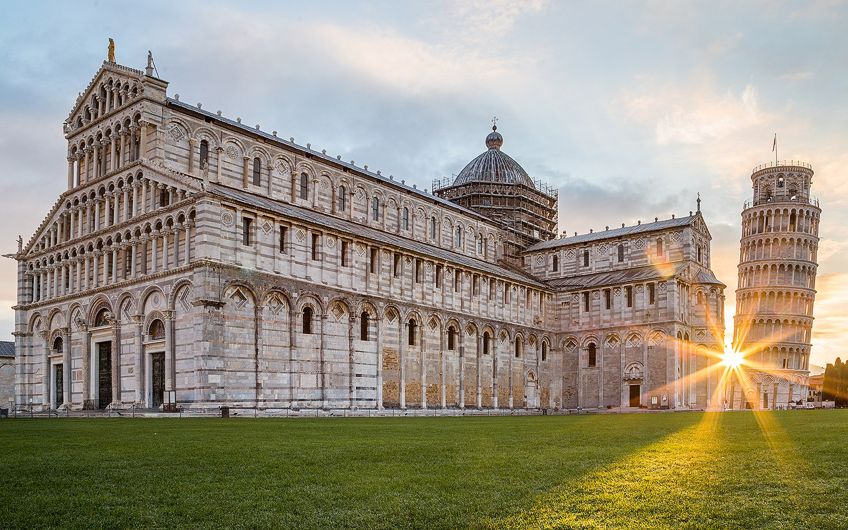 The Duomo and Tower of Pisa at sunrise; MHoser, CC Past-SA iv.0, via Wikimedia Eatables
The Duomo di Pisa, which is the front entrance of the Pisa Cathedral, is a lavishly decorated façade. There are three doorways, with "blind" arcades side by side to each ane (totaling 4 blind arcades interspersed betwixt the real doors). Some of the influences on this building come from the Lombard Romanesque style, too as Islamic and Byzantine styles. We come across the characteristic Lombard bands on the arches and columns. There are crescent-shaped Romanesque paintings higher up each doorway with Islamic-styled shapes described equally diamonds and circles.
The levels above have arcades and columns that announced elaborately decorative when the building is viewed from afar. All the same, when viewed close-upwards, nosotros besides see the level of item in each part of the building.
The Romanesque Style Continues to Influence
The Gothic fashion developed in Paris effectually the yr 1120 CE, which then started to stage out the Romanesque period. However, the advent of the Gothic manner yet utilized Romanesque influences. For case, churches connected to utilise the cruciform pattern plans, including the western-facing façade with the characteristic ii towers.
In the 1800s, at that place was a Romanesque revival in diverse buildings and churches. Some mutual examples include the Natural History Museum (1879) located in London. Other buildings in America include the Maaronite Cathedral of Our Lady of Lebanon (1844 to 1846) past Richard Upjohn.
The style has also been adjusted by the American architect Henry Hobson Richardson, who designed buildings similar the Marshall Field Wholesale Shop (1885 to 1887) located in Chicago. This was later known as the Richardsonian Romanesque style with diverse other architects working alongside Richardson and his manner.
The Romanesque fashion became a foundational precursor to other architectural styles. Not only did it infringe from Classical compages, just it also crossed paths with Byzantine styles. It was not simply relegated to architecture but spanned across various artistic modalities like illuminated manuscripts and mosaics. From Classical to Modern, the Romanesque style has been adapted and molded to suit churches, cathedrals, section stores, and warehouses.
Take a look at our Romanesque art menstruum webstory here!
Frequently Asked Questions
What Is Romanesque Art?
Romanesque fine art was primarily an architectural style that drew from the Classical Greek and Roman architectural styles. It likewise drew inspiration from Byzantine and Islamic styles. This art period did not just include architecture, however – there were other fine art forms like metalwork, sculpture, painting similar murals and mosaics, embroidery, and stained glass.
When Did the Romanesque Period Starting time?
The Romanesque period occurred during the Medieval, or Middle Ages. It started around the mid-10thursday century CE until the 12thursday Century CE. It originated in unlike parts of Europe, predominantly French republic, Italian republic, England, and Northern parts of Europe like Frg.
What Are the Characteristics of Romanesque Architecture?
The common characteristics of Romanesque architecture are solidity, strength, thick and large-scaled walls, piers, and columns (either small or large, depending on the placement inside or exterior the church). Other features include arches, unremarkably called "blind" arches and decorative arcades. Buildings usually had wooden roofs and vaulting in the forms of Barrel, Ribbed, Groin, and Pointed Curvation. Entrances were west-facing with feature towers, sometimes ane tower on smaller churches and two towers on larger cathedrals.
Source: https://artincontext.org/romanesque-art/
0 Response to "Art History I El4002 Which of the Following Is Not a Characteristic of Romanesque Architecture?"
Post a Comment